Multi-tenant platform · Luby
Your whole business.
In a single system.
LubyOS is a cloud operating system for services companies. A desktop with applications for CRM, projects, timesheet, talent and knowledge, all on a unified data layer. That unification is what makes it possible to answer questions spanning several domains without an integration project in between.
Adoption is incremental. Existing systems remain in operation while the unified view is already available.
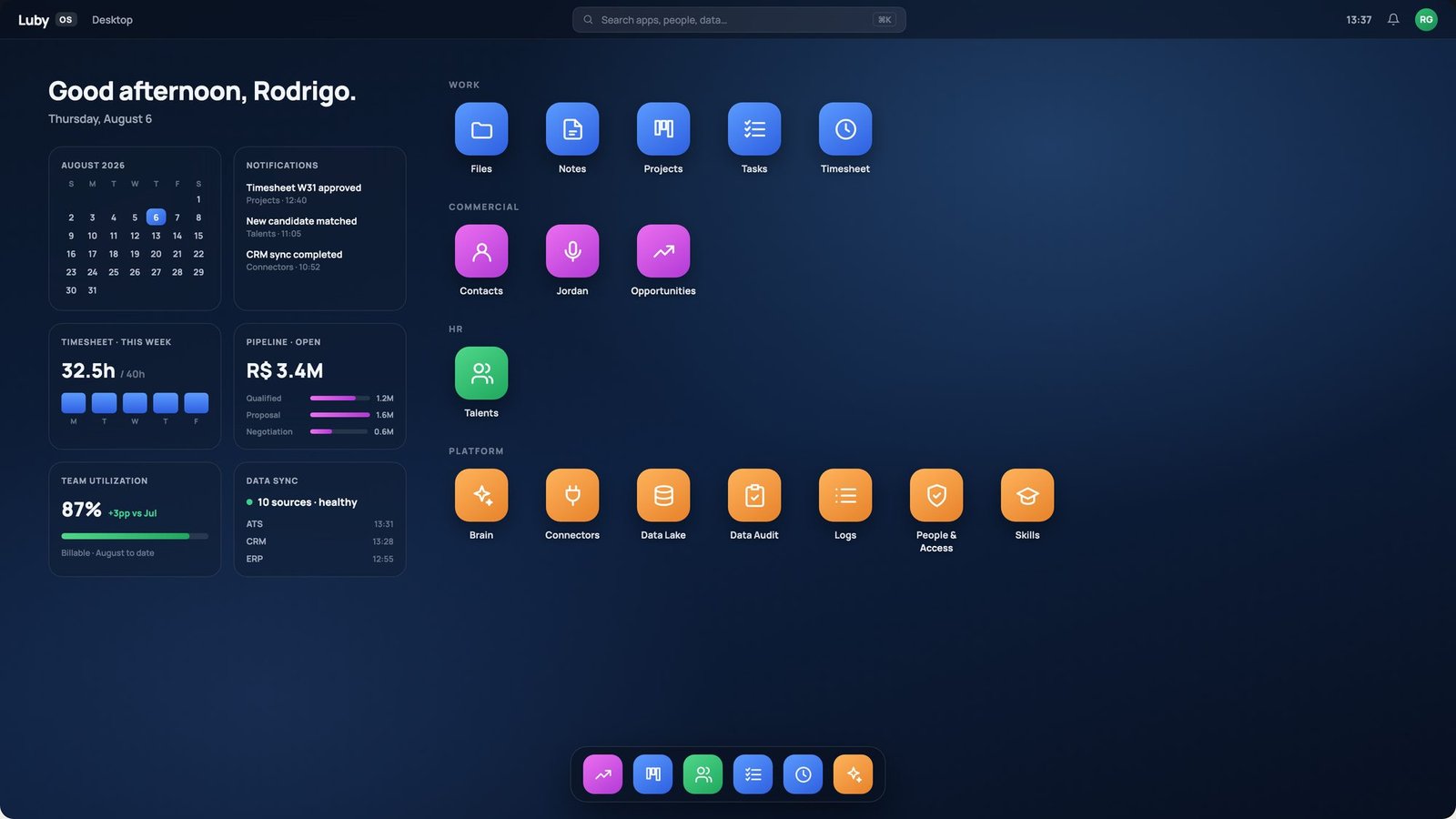
Every figure on this site reflects the current state of the product and is verified against the repository.
The context
The information already exists, distributed across systems that do not communicate.
A services company operates by balancing capacity — the people available — against demand — the projects under contract, while preserving the margin on each allocation. The data supporting that decision already exists; what is missing is that it be brought together.
Each system holds part of the information
The ATS, the CRM, the project tracker, the ERP and the productivity suite each record fragments of the same business, with no shared vocabulary between them. Consolidation happens outside the systems, in manual exports and intermediate spreadsheets.
The same person holds multiple identities
A professional appears under one identifier in the ATS, another in the corporate directory, another in the project tool and another in payroll. Reconciling those records manually is a recurring cost that rarely appears in any budget.
Two indicators determine the outcome
Utilization and margin per allocation define quarterly performance. When they depend on manual consolidation, they arrive late and approximate — frequently after the decision that depended on them.
Beyond the cost of the licences sits the cost of decisions taken on outdated data: idle capacity identified late, and projects whose margin deteriorates without signalling.
The system
The six areas of the system.
Each of the areas below is implemented and in operation. The pages detail the architecture, the mechanics and the boundaries of each one.
Product and architecture
Shell, kernel and applications. The single point of data access, the manifest as a contract, and extensibility through in-house modules.
See the architecture →Native applications
Twenty-five applications in the catalog, sixteen installed and in use, under a single authentication and a single permission model.
See the applications →Data and integration
592 connectors, a three-layer pipeline, and identity resolution with field-level provenance and full reversibility.
See the data layer →Brain
Corporate knowledge, versioned, indexed and searchable, with mandatory citation of the document supporting each answer.
See the Brain →AI, search and agents
Hybrid search with authorization applied inside the index, MCP servers in production, and the conditions a corporate agent needs to find in place.
See AI and search →Security
Isolation enforced by the database, object-level authorization in a graph, and an audit of both granted and denied access.
See security →Current state
What is implemented and in operation.
The platform is in use at Luby, with real production data. Every item in this list can be demonstrated in a live environment.
| Complete shell: desktop, windows, dock, global search and design system | In operation |
| Application platform: catalog, manifest, publication and installation — 25 applications, 16 installed | In operation |
| Kernel: multi-tenant isolation, object-level authorization, audit and federated authentication | In operation |
| Catalog of 592 connectors and ingestion in production from 10 sources | In operation |
| Raw → normalized → consolidated pipeline, serving CRM, talent and projects | In operation |
| Identity resolution: data model, reversible merge and calibration application | In operation |
| Brain: index, application, entity graph, hybrid search and coverage telemetry | In operation |
| MCP servers for engineering standards and operational knowledge | In operation |
| React Native mobile application for iOS and Android | In operation |
Frequently asked questions
Recurring questions during evaluation.
How does this differ from an ERP?
An ERP delivers a fixed set of modules on the vendor's database. LubyOS delivers a platform on which modules — including those built by your team — operate on your data layer. That characteristic is what makes queries and automations spanning domains feasible, which they are not when each module keeps its own database.
How long until there is measurable return?
The first stage, connecting the sources, delivers the consolidated view without changing team routines. Value does not depend on completing the migration.
What is the Brain, and who maintains the content?
It is corporate knowledge in versioned textual form, with a named owner and a date per document. Maintenance is carried out by the areas themselves, through reviewed proposals. The MCP servers operate read-only, and the system records queries without a satisfactory answer, which sets documentation priority.
Is company data used to train models?
No. The semantic search index runs on our own infrastructure, and indexed content is not sent to external services. Where an external language model is used by an application, that is stated in the manifest and outbound traffic is restricted to what was declared.
How is segregation between clients guaranteed?
Isolation is enforced by the database, across every table, and does not depend on the application being correct. Clients with a specific regulatory requirement are given a dedicated database.
How is integration with AI agents controlled?
The agent is treated as another client of the same authorization graph. Content retrieval is filtered inside the index before any call to the model, write actions require human confirmation and travel the standard authorized route, and the whole path is recorded in the audit log.
Do all systems have to be replaced at once?
No. The model is to connect, take over one domain at a time, and decommission the previous system afterwards, at the pace the client sets.
What happens if the contract ends?
Raw data remains the client's property, in an open, immutable and exportable format. The licences used on the critical path are permissive open source, with no contractual exit restriction.
Does the platform serve companies in other sectors?
The platform is generic. The allocation and time-logging applications are specialized for services companies, where the problem is most acute. Organizations structured around projects, people and hours find direct applicability.
Start with the domain of greatest impact.
Connect one source, assess the consolidated data layer, and decide the sequence based on evidence.
Twenty minutes, with the system in operation and a query that spans the domains of your own operation.