
Product
A desktop on the surface,
a platform underneath.
The interface is a desktop: a grid of applications, windows, global search and a single visual language. Underneath, each application is an independent module, and all of them reach data exclusively through the kernel — which enforces isolation, authorization and auditing on every request.
The three layers
Three layers: interface, kernel and applications.
Shell
Desktop, windows, dock, top bar, application catalog, global search and notifications. The grid each person receives is composed by the kernel from what is installed for the client and what that user is permitted to open.
Kernel
The single point of access to data and capabilities. Every read and every write passes through it, where client isolation, the user's permission over the object and the audit record are applied. Access to the database happens only along that route.
Applications
Independent modules installed per client: timesheet, projects, CRM, talent, knowledge and the platform tools. Each declares in a manifest what it needs to access, and receives what it declared.
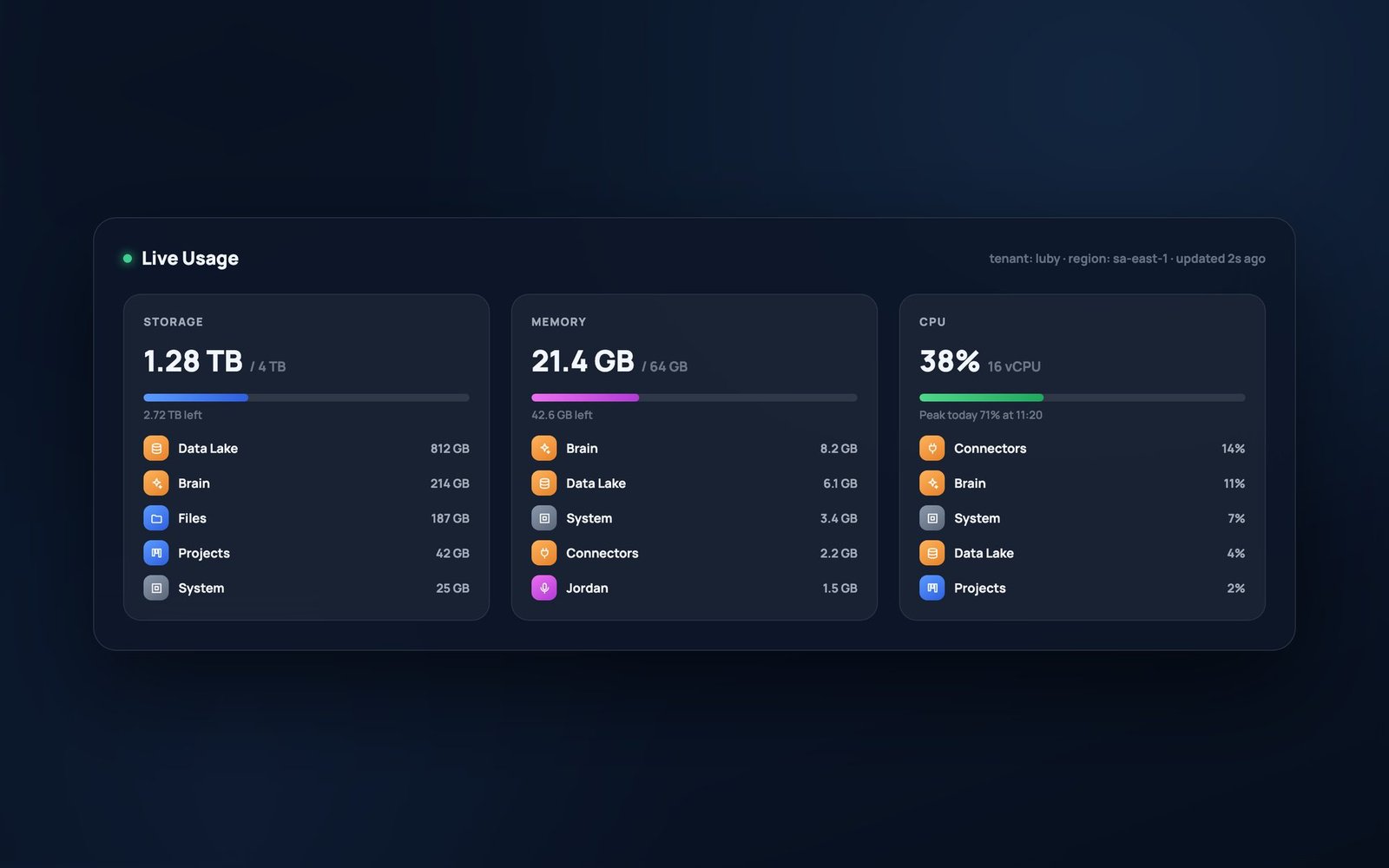
Application and data permissions are enforced by the kernel, at the same point the interface, the applications and any connected AI agent pass through.
Extensibility
Your own modules, on the same platform.
Traditional management systems concentrate customization at the vendor, which turns every specific requirement into a demand prioritized externally. In LubyOS, modules are installed from the catalog, and organizations with their own team publish their own.
- The manifest is the contract. Each module declares the tools it uses, the events it consumes, the data it accesses, the permissions it requests and the authorized external destinations. The platform grants exactly what was declared.
- Immutability per version. Changes to the contract require a new version. Republishing an existing version with different content is rejected, which prevents silent scope expansion.
- Third-party isolation. Execution in a segregated environment, in any language, with access mediated by the platform and no contact with other modules' credentials.
- Transactional installation. The application record and the corresponding permissions are written in the same transaction, with no intermediate state.
Mobile
A dedicated interface for use in the field.
LubyOS Mobile adopts a different metaphor from the web version. The home screen is a conversation with voice input, and the application grid occupies the second tab.
The choice answers a difference in context: at a desk the professional knows which application to open; in the field, they know which task to complete, and should not need to identify which module it lives in.
- Recording at the moment of the event, reducing the distance between occurrence and entry — the main source of imprecision in hour logging.
- Approvals with context, rather than bulk approval at the end of the period.
- Access to corporate knowledge during meetings and client visits.
- Mandatory human confirmation on any write action, with the kernel applying authorization and recording the audit entry.
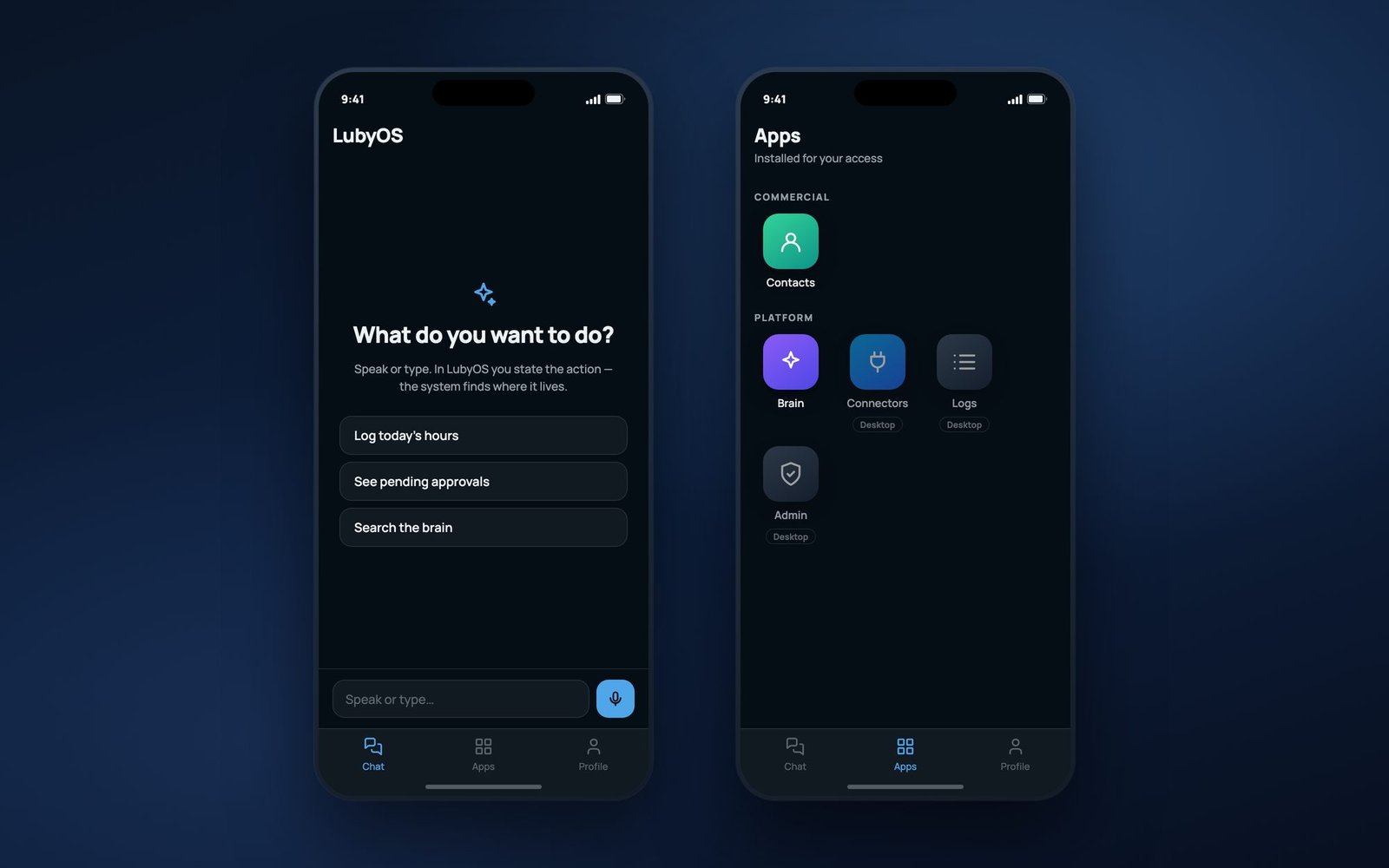
A React Native application for iOS and Android, on the same design tokens and the same identity model as the web version.